
Industrial Machinery & Manufacturing
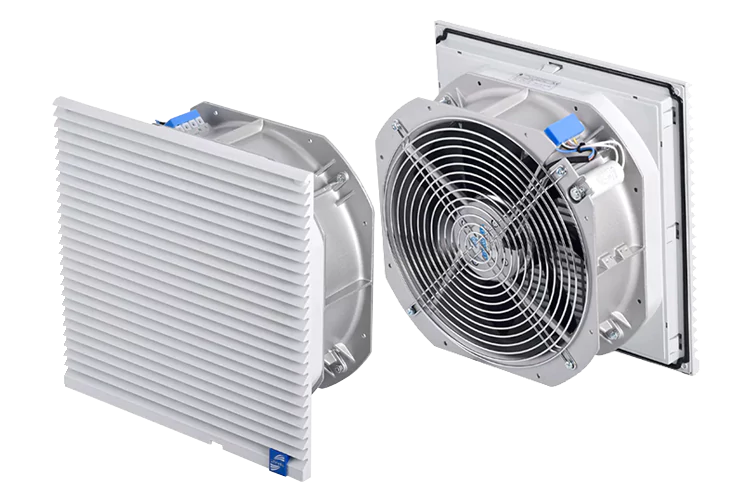
What to consider when choosing cooling fans for cabinets?
First, the thermal load parameters must be calculated. Generally, the total heat generated by the electronic components inside the cabinet needs to be quantified in watts. For example, the peak thermal load of a control cabinet equipped with 10 servo drives can reach 650 watts. According to the ASHRAE standard of the American Society of Heating, Refrigerating and Air-Conditioning Engineers, approximately 3,400 BTU/h of heat is generated for every 1 kilowatt of electrical energy consumed, which means that a cooling device with an air volume of at least 150 CFM needs to be configured. Actual measurements show that when the internal temperature exceeds 55°C, the probability of integrated circuit failure will increase by 30%. Therefore, when selecting a fan, it is necessary to ensure that the temperature rise is controlled within a safe range of 15°C.
The protection level index directly determines the service life of the equipment. In environments such as food processing plants where the humidity exceeds 80%, products with IP65 or higher specifications should be selected. For instance, Schneider Electric's VENT206 series fans have passed the ISO 14644-1 certification and can effectively block dust particles larger than 12 microns. Case analysis shows that after a certain chemical plant upgraded its IP54-rated fans to IP67, the annual failure rate of the equipment dropped from 5 to 0.8 times, and the maintenance cost decreased by 42%. These verified cooling fans for cabinets can withstand 144 hours of corrosion in salt spray tests and extend service life to 60,000 hours.
Noise control shall comply with OSHA 29 CFR 1910.95 specification. The allowable noise exposure limit for industrial areas is 85 decibels for 8 hours. Fans adopting DC brushless technology can keep the sound pressure level below 45 decibels. For instance, Delta Electronics' AFB series only generates 52 decibels of noise at a full-load speed of 3200 RPM. A comparative study indicates that reducing noise from 70 decibels to 50 decibels can increase workers' productivity by 7% and simultaneously decrease the operational error rate by 15%.
 The energy efficiency ratio has a significant impact on operating costs. EC fans that comply with the EU ERP 2019 regulation are 30% more energy-efficient than traditional AC models. Take a 25-watt fan as an example. Under the industrial electricity price of 0.12 US dollars per kilowatt-hour, the annual electricity cost difference for a single unit amounts to 26 US dollars. The case implemented by ABB Group shows that after deploying 2,000 high-efficiency fans in its global factories, it saved over 100,000 kilowatt-hours of electricity annually and reduced carbon dioxide emissions by 80 tons.
Intelligent monitoring functions are becoming a new trend. Fans equipped with IoT sensors can detect abnormal conditions in real time when the wind speed deviation exceeds 15%. Data from market research firm Frost & Sullivan shows that cooling systems integrated with predictive maintenance functions can reduce unexpected downtime by 40% and shorten the payback period to 14 months. For instance, the intelligent fan equipped in the Siemens G120 frequency conversion cabinet can upload bearing vibration data every 100 milliseconds via the PROFIBUS protocol, enabling a 96-hour early warning of faults.
The total cost of ownership analysis should cover the entire life cycle, with the initial procurement cost accounting for only 10%, while energy consumption and maintenance account for as high as 70%. Choosing a product with an MTBF exceeding 100,000 hours can reduce the total cost over a five-year period by 25%. Reliability verification conducted in accordance with the IEEE 1413 standard shows that the performance degradation of high-quality fans after continuous operation at an ambient temperature of 40°C for three years should be less than 5%.
The energy efficiency ratio has a significant impact on operating costs. EC fans that comply with the EU ERP 2019 regulation are 30% more energy-efficient than traditional AC models. Take a 25-watt fan as an example. Under the industrial electricity price of 0.12 US dollars per kilowatt-hour, the annual electricity cost difference for a single unit amounts to 26 US dollars. The case implemented by ABB Group shows that after deploying 2,000 high-efficiency fans in its global factories, it saved over 100,000 kilowatt-hours of electricity annually and reduced carbon dioxide emissions by 80 tons.
Intelligent monitoring functions are becoming a new trend. Fans equipped with IoT sensors can detect abnormal conditions in real time when the wind speed deviation exceeds 15%. Data from market research firm Frost & Sullivan shows that cooling systems integrated with predictive maintenance functions can reduce unexpected downtime by 40% and shorten the payback period to 14 months. For instance, the intelligent fan equipped in the Siemens G120 frequency conversion cabinet can upload bearing vibration data every 100 milliseconds via the PROFIBUS protocol, enabling a 96-hour early warning of faults.
The total cost of ownership analysis should cover the entire life cycle, with the initial procurement cost accounting for only 10%, while energy consumption and maintenance account for as high as 70%. Choosing a product with an MTBF exceeding 100,000 hours can reduce the total cost over a five-year period by 25%. Reliability verification conducted in accordance with the IEEE 1413 standard shows that the performance degradation of high-quality fans after continuous operation at an ambient temperature of 40°C for three years should be less than 5%.
The energy efficiency ratio has a significant impact on operating costs. EC fans that comply with the EU ERP 2019 regulation are 30% more energy-efficient than traditional AC models. Take a 25-watt fan as an example. Under the industrial electricity price of 0.12 US dollars per kilowatt-hour, the annual electricity cost difference for a single unit amounts to 26 US dollars. The case implemented by ABB Group shows that after deploying 2,000 high-efficiency fans in its global factories, it saved over 100,000 kilowatt-hours of electricity annually and reduced carbon dioxide emissions by 80 tons.
Intelligent monitoring functions are becoming a new trend. Fans equipped with IoT sensors can detect abnormal conditions in real time when the wind speed deviation exceeds 15%. Data from market research firm Frost & Sullivan shows that cooling systems integrated with predictive maintenance functions can reduce unexpected downtime by 40% and shorten the payback period to 14 months. For instance, the intelligent fan equipped in the Siemens G120 frequency conversion cabinet can upload bearing vibration data every 100 milliseconds via the PROFIBUS protocol, enabling a 96-hour early warning of faults.
The total cost of ownership analysis should cover the entire life cycle, with the initial procurement cost accounting for only 10%, while energy consumption and maintenance account for as high as 70%. Choosing a product with an MTBF exceeding 100,000 hours can reduce the total cost over a five-year period by 25%. Reliability verification conducted in accordance with the IEEE 1413 standard shows that the performance degradation of high-quality fans after continuous operation at an ambient temperature of 40°C for three years should be less than 5%.