
What 49 TH/s Earns Before You Buy the Machine
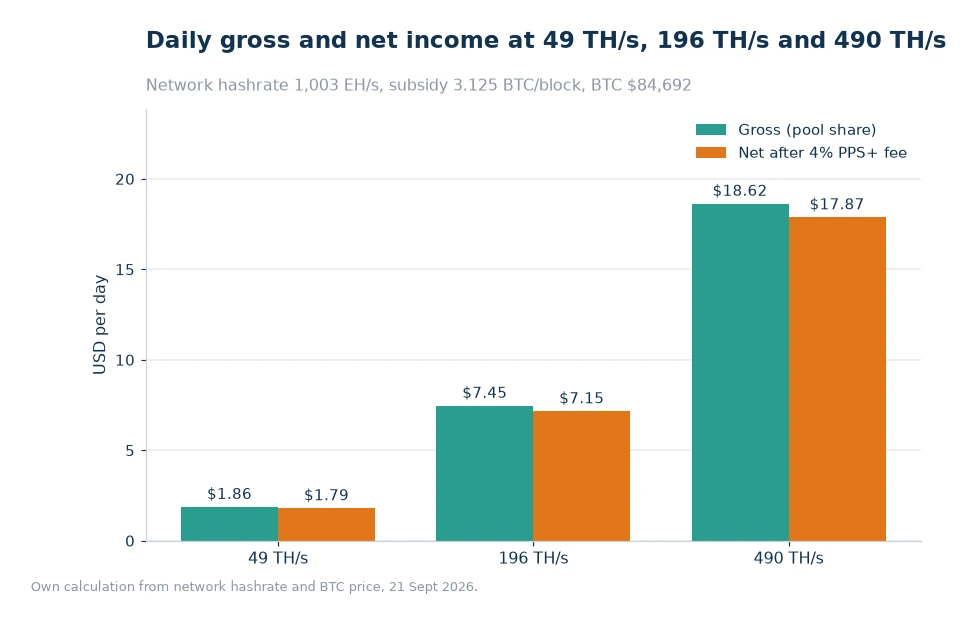
A 49 TH/s miner at current network conditions credits about 0.00002198 BTC a day, worth $1.86 at $84,692 per coin, or $1.79 once the listed 4% on the block-reward component is taken out. Scale that to 196 TH/s and the gross becomes $7.45; at 490 TH/s it is $18.62. The number that decides whether the purchase makes sense is smaller than any of them, because the machine has to pay for its own electricity first.

Key takeaways
- 49 TH/s grosses $1.86 a day and nets $1.79 after the listed 4% on the block-reward component.
- Hashrate scales income in a straight line, so 490 TH/s pays exactly ten times what 49 TH/s pays.
- At 20 J/TH and $0.06/kWh, a 49 TH/s unit burns about $1.41 of power a day, leaving roughly $0.38.
- Check the difficulty estimate and the coin price before signing: both move the daily figure by several percent.
Three tiers on one straight line
The chart compares 49, 196 and 490 TH/s, and the steps are chosen to make a point. Each tier is a multiple of the one below, and the dollar values follow the same multiple with no curve or bend. Ten times the hashrate returns ten times the coins, because a pool pays out a share of a fixed daily issuance: 144 blocks at 3.125 BTC each, or 450 BTC across the whole network every day.
For a buyer, that linearity is the most useful property on the spec sheet, since it converts every hashrate claim into a division problem. Halve the machines and you halve the income. What refuses to scale is the overhead around each unit: a power supply, a shelf, a fan tray, a network cable and a trip to the post office all repeat per machine. Small setups therefore carry a heavier fixed-cost layer than large ones, and the same is true of attention.
Two subtractions, often mistaken for one
The pool takes a listed 4% on the block-reward part of PPS+ income and a listed 2% on the transaction-fee part, which is distributed on PPLNS logic. Those are separate rates on separate components, not a single charge on the total. At 49 TH/s the block reward dominates, so the practical haircut lands close to 4%: $1.86 becomes $1.79. A miner who assumes a flat percentage of everything will be a few cents off per day, and a few cents a day is how the annual comparison goes wrong.
The second subtraction is electricity, and it is usually the larger of the two. A pool fee is a known fraction of a known number. A power bill depends on the efficiency of the board, the local tariff and how many hours the unit actually runs. That is why two people with identical machines can report very different results without either of them exaggerating.
Where the coins meet the meter
Take a machine running at 20 J/TH. At 49 TH/s that is 980 W, or 23.52 kWh over a day. At $0.06/kWh the power costs $1.41, which sits against $1.79 of pool income and leaves about $0.38. The same assumption applied to the larger tiers leaves $1.51 at 196 TH/s and $3.77 at 490 TH/s, because the fixed costs inside the machine are spread over more boards.
Notice how thin that margin is at the bottom. A tariff of $0.08 rather than $0.06 adds $0.47 a day to the 49 TH/s unit and turns a small positive into a small negative. Nothing about the mining arithmetic changed; only the price of a kilowatt-hour did. This is the reason a first purchase should start with a meter reading and a utility bill, not with a hashrate figure from a marketplace listing.
What a difficulty estimate is worth
The network difficulty was 132.76 T when these figures were read, against a hashrate of roughly 1,003 EH/s, and the next adjustment was estimated at −2.12%. A drop of that size would lift every daily credit by about 2.2% if it lands, which on $1.86 is four cents. It is not a reason to buy, and it is not a reason to wait. It is a reminder that the daily number printed on any calculator is a snapshot, and snapshots expire.
Treat the estimate as a scheduling input instead. If a difficulty fall is expected within the week, a miner planning to move machines or change payout schemes may as well finish the move first. The live pool state page shows how the pool's own hashrate is tracking, which is the number that decides whether your share of the next round is diluted or not.
What the account should do for you
Once the hardware decision is made, the operational choice is where the coins land. Buying into ViaBTC Crypto Mining puts the pool account, the wallet and the payout address behind a single login. A multi-currency wallet inside the same account removes a transfer step, and Auto Conversion lets a miner hold the payout in a different unit without moving it off the platform. Withdrawals of mining income carry no fee, so the cost of taking coins out does not enter the daily arithmetic above.
Before committing to a model, run the numbers through the Profit Calculator with your own tariff and your own hashrate, then check the same machine against the Miner Profitability Ranking. The two views answer different questions: one asks what this unit would earn today, the other asks how it compares with the alternatives on the shelf.
Comparing tiers after the meter
The table keeps the pool fee and the power bill in separate columns so the two never blur into a single "net" figure. Power is priced at 20 J/TH and $0.06/kWh, which is an assumption to be replaced with your own numbers, not a quote.
| Tier | Gross income | After listed fee | Power cost | Left over |
|---|---|---|---|---|
| 49 TH/s | $1.86 | $1.79 | $1.41 | $0.38 |
| 196 TH/s | $7.45 | $7.15 | $5.64 | $1.51 |
| 490 TH/s | $18.62 | $17.87 | $14.11 | $3.77 |
Worked example
Follow the 49 TH/s column from the network total down to the cent.
- Start at the network: 450 BTC issued per day divided by 1,003,000,000 TH/s of hashrate gives 0.00000044865 BTC per TH/s.
- 49 TH/s: 49 × 0.00000044865 = 0.000021984 BTC a day.
- Gross dollars: 0.000021984 × 84,692 = $1.8618, rounded to $1.86.
- After the listed 4%: 1.8618 × 0.96 = $1.7873, rounded to $1.79.
- 196 TH/s: 4 × 0.000021984 = 0.000087936 BTC, or $7.4472 gross and $7.1493 net.
- 490 TH/s: 10 × 0.000021984 = 0.00021984 BTC, or $18.618 gross and $17.873 net.
- Power at 49 TH/s: 49 × 20 J = 980 W; 0.98 kW × 24 h = 23.52 kWh; × $0.06 = $1.4112.
Frequently asked questions
How much does a 49 TH/s miner earn in a day?
At a network hashrate of 1,003 EH/s and BTC at $84,692, it mines 0.00002198 BTC, or $1.86 gross and $1.79 after the listed 4% on the block-reward component.
Does a bigger machine earn proportionally more?
Yes for income: 490 TH/s returns exactly ten times the coins of 49 TH/s. Costs behave differently, since power, cooling and repairs grow with the hardware while the account, the wallet and the pool fee stay the same shape.
Should a first purchase be sized by hashrate or by wattage?
Wattage first. A unit drawing 980 W needs a circuit that can carry it and a tariff that leaves room under the $1.79 daily credit; hashrate only tells you the numerator of that ratio.
Price the socket before the hashboard
Write down the all-in cost of a kilowatt-hour where the machine will stand, multiply by the daily consumption, and subtract that from the pool credit for your tier. If the remainder is comfortable at today's price and still positive after a difficulty rise, the purchase has room to breathe. If it depends on the coin doubling, the machine is a bet on the coin rather than a mining decision.
Chain data read 21 Sept 2026: 1,003 EH/s of network hashrate, difficulty 132.76 T, 3.125 BTC per block, BTC at $84,692. Listed pool fees from the ViaBTC pricing page[1]. Published 24 Oct 2026. Power figures are an assumption at 20 J/TH and $0.06/kWh, not a quote.