
From Brief to Bulk: The Perfume Production Process a Retailer Should Know
A fragrance OEM/ODM project moves through the same seven stages whether the product is a fine perfume, a room spray or a body mist: brief, formula, sample, stability, artwork, bulk and release. The retailers who finish on time are the ones who treat the sequence as a document trail rather than a series of conversations. This is the step-by-step process — and where each step usually goes wrong.
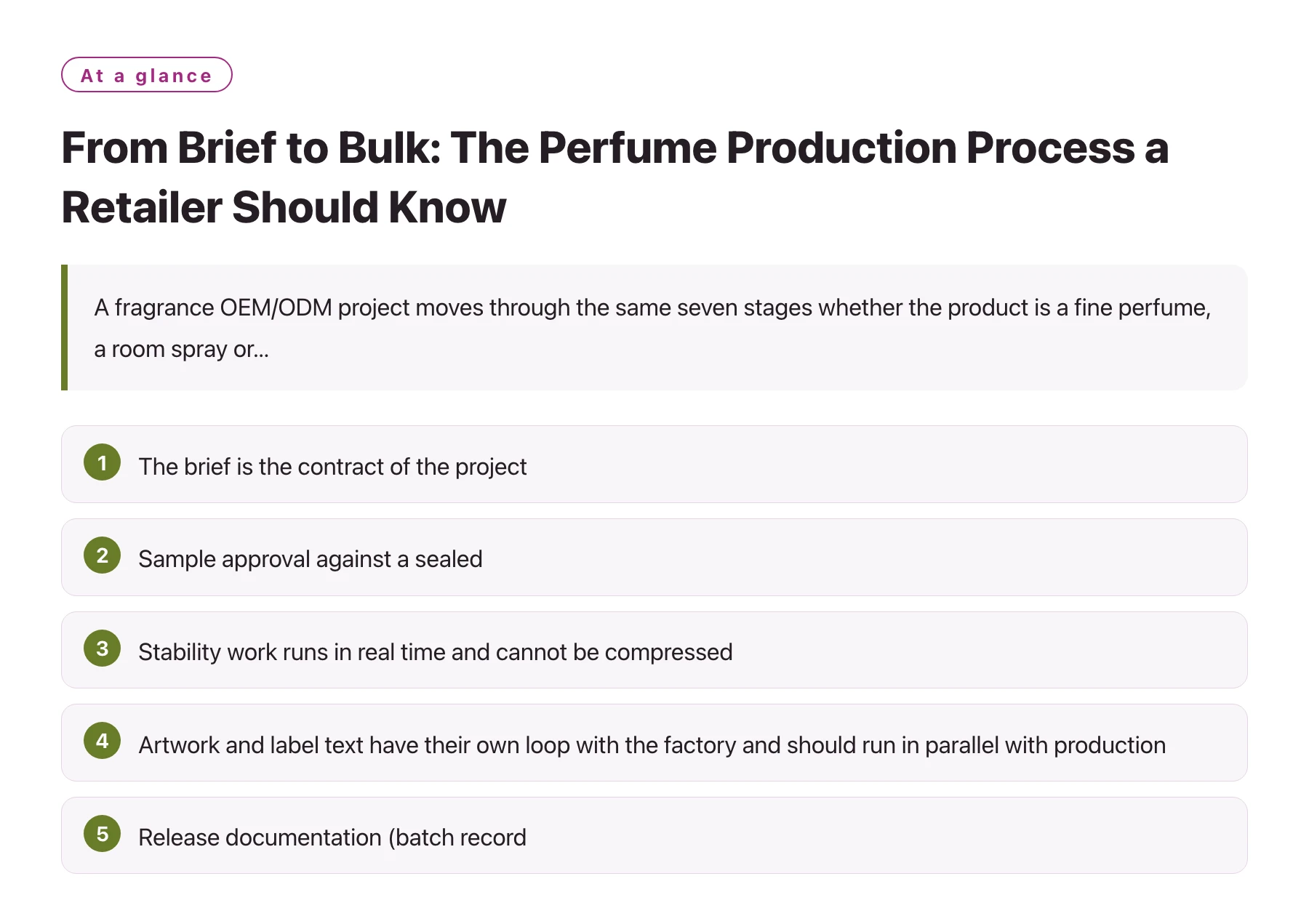
Key takeaways
- The brief is the contract of the project; a vague brief produces a long sample round and a scent nobody agreed to.
- Sample approval against a sealed, dated reference is what makes the bulk order repeatable.
- Stability work runs in real time and cannot be compressed, so it should start the day the formula is approved.
- Artwork and label text have their own loop with the factory and should run in parallel with production, not after it.
- Release documentation (batch record, safety assessment, IFRA statement) is part of production, not a favour the factory does afterwards.
Every manufacturer describes its process differently, which makes projects hard to compare. Under the differences, though, the sequence is the same, because the physics and the regulations are the same.
Here is the sequence as a buyer should see it: what happens at each stage, what you are expected to provide, and what should be written down.
The seven-stage sequence
- Brief and feasibilityYou describe the product: format, scent direction, audience and market. The factory turns that into a technical brief, and you approve the technical brief in writing.
- Formula developmentFor ODM, the factory selects or adapts an existing base; for OEM, your formula or your perfumer's brief is built out. You receive a sample with a dosage statement — the usage limits applied to fragrance materials are part of this stage, not an afterthought [1].
- Sample round and approvalAt least two rounds: one to set the direction, one to confirm the reference. Approval is against a sealed, dated physical sample, confirmed in writing.
- Stability and safetySamples go into stability — heat, light, shelf life — and the safety assessment for your market begins. This is the stage that cannot be rushed, because it runs in real time [2].
- Artwork and packagingLabel text, bottle, carton and decoration are locked. The compliance text on the label (ingredient list, warnings) must come from the factory's formula documentation, never from a designer's memory.
- Bulk productionCompounding, filling, packing and labelling to the approved reference. The factory keeps a batch record from raw material intake to release.
- QC release and shippingRelease testing against the reference, the document pack assembled, freight booked. Your side checks the documents against your market's requirement list, including which ingredients may and may not appear in the product class you are selling [3].
Where the sequence usually stalls
The parallel steps are run serially
Stability and artwork are independent, but many retailers discover the artwork late and then wait for stability anyway. Start both the day the formula is approved, and the calendar shrinks by the length of the slower one.
The approval is not an approval
A text message saying "it's nice" is a comment, not a sign-off. Every sample round should end with either a written approval of a named reference or a written list of what changes. The grey zone in between is where bulk orders drift.
Dosage is treated as a fixed cost
Changing the dosage to adjust strength changes cost, stability and the label maths. Decide the dosage in the brief stage and change it deliberately, not by accident, because late dosage changes restart part of the stability work.
Who brings what
| Stage | You provide | The factory provides |
|---|---|---|
| Brief | Format, scent direction, market, price target | Technical brief, feasibility check, timeline |
| Formula | For OEM: the formula or the perfumer's brief | For ODM: a matching base, dosage, first samples |
| Sample | Written feedback per round | Samples and the dosage or usage statement [1] |
| Stability | The accepted test range and claims | Stability protocol and results [2] |
| Artwork | Final label and pack design | Print-ready checks, barcode, compliance text |
| Bulk | Purchase order and the approved reference | Filling, packing, labelling, batch record |
| Release | The market document checklist | Safety assessment, batch certificate, shipping documents |
Read the middle column as your own job list. The stages where the buyer has nothing to provide are the stages where the buyer loses control.
The scope question that ties it together
The whole process is simpler to manage when compounding, filling and packaging happen under one roof, because the document trail stays in one company. Check the service scope first: a manufacturer that lists compounding, filling and finishing in that scope — for example the page describing Xuelei perfume production Xuelei perfume production — lets a buyer map the seven stages onto one list and one contact person.
For a brand that wants to start without its own formula, the ODM route handles stages two and three for you: a full ODM fragrance service full ODM fragrance service hands over the formula, the dosage and the first samples as a package, and the retailer's job becomes direction, approval and market. When the scent is the brand instead, treat the factory as a custom fragrance development partner custom fragrance development partner and expect the development stage to cost more in time and money than it would in ODM — that is the price of owning the formula.
Sources
- IFRA Standards Library (International Fragrance Association) —— The IFRA Standards Library lists the restrictions the fragrance industry applies to individual fragrance ingredients, based on safety assessments; it is the reference point for compliant fragrance formulation.
- SGS: Cosmetics, Personal Care & Household Testing —— Testing, inspection and certification services for cosmetics and personal care, including microbiological, stability and safety testing aligned with cosmetics GMP.
- EU CosIng — Cosmetic Ingredient Database (European Commission) —— The European Commission's CosIng database of cosmetic ingredients, listing ingredient functions, restrictions and labelling requirements under EU cosmetics law.
Frequently asked questions
How many sample rounds are normal?
At least two: one to set the direction, one to confirm. A third is normal when the scent or the pack changes. The number that should worry you is zero — approving without a sample round is a guess, not a decision.
Can stability be skipped for a small first order?
It can be, and small orders sometimes do — but that is a risk decision, not a saving. Heat-sensitive formats such as car clips and gels are exactly the ones where skipping hurts most.
Who writes the ingredient list?
The factory, from the formula documentation; your designer typesets it. Never let label text be written by copying another product's pack, because the list must match the formula actually filled in the bulk order.
What is in a batch record?
The recipe used, the raw material lots, the fill weights, the line checks and the release testing for one production run — the evidence that the bulk order really matched the approved reference.
How long does the whole process take?
The honest answer depends on sample rounds and the stability window. What is predictable is the sequence: stability and artwork start early, and the first bulk date is set by the slowest parallel step, not the fastest one.